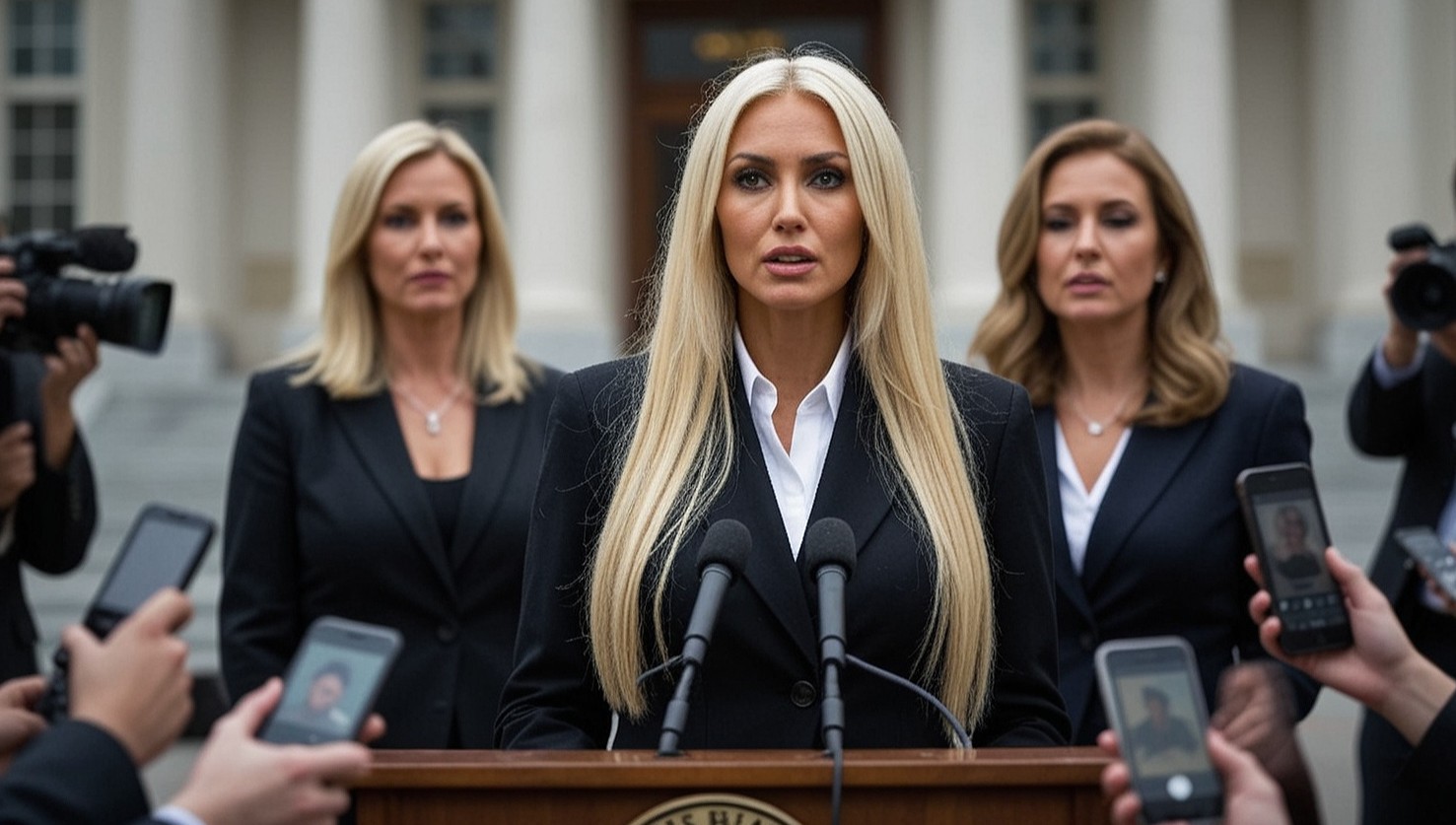
Paris Hilton returned to Capitol Hill on Tuesday with a bipartisan pair of congresswomen and a stalled bill — and a demand that House leadership finally put it on the floor. The DEFIANCE Act would give victims of explicit deepfakes a federal right to sue. If you generate AI porn of real people, it’s aimed at you (and definitely not Paris herself when she posts spicy deepfaked photos of herself with Tom Cruise).
Hilton stood outside the Capitol on Tuesday, ten months after her first trip there for the same cause, and framed the ask in personal terms: an explicit tape of her leaked when she was 19, and she says more than 100,000 AI-generated explicit images of her now exist online.
“Ten months ago, I stood here at the Capitol and told the world what it feels like to have your body exposed without your consent, and I asked Congress to do something about it,” Hilton said. “The laws aren’t protecting us. And if this can happen to someone with my resources and my platform, imagine how powerless a young girl might be feeling facing this completely alone.”
She was joined by Rep. Alexandria Ocasio-Cortez (D-NY) and Rep. Laurel Lee (R-FL), the two leads on the House companion bill, H.R. 3562. Hilton’s team, per her own count, found that 83 of the 156 women currently serving in Congress already have sexual deepfakes online. She also put the global victim count at 50 million people.
“Speaker Johnson, Leader Scalise, Chairman Jordan: I am speaking directly to you,” she said. “Will you allow this to continue to happen to your colleagues?”
What the DEFIANCE Act actually does
The bill — the Disrupt Explicit Forged Images And Non-Consensual Edits Act, S. 1837 — passed the Senate by unanimous consent on January 13, 2026. It also passed the Senate in 2024. The House has never voted on it. Full text is here.
It does not create a new law. It amends an existing one — Section 1309 of the Consolidated Appropriations Act, 2022, codified at 15 U.S.C. 6851 — to cover “intimate digital forgeries.” Here’s what’s in it:
| Provision | What it says |
|---|---|
| Who can be sued | Anyone who knowingly produced or possessed the forgery with intent to disclose, knowingly disclosed it, or knowingly solicited and received it. You don’t have to publish to be on the hook — production alone counts if the subject didn’t consent and was harmed or likely to be harmed. |
| Mens rea | The defendant must have known or recklessly disregarded that the subject didn’t consent. |
| Minimum damages | $150,000 in liquidated damages, no proof of financial loss required. |
| Escalated damages | $250,000 if the conduct is tied to actual or attempted sexual assault, stalking, or harassment. |
| Other remedies | Actual damages, the defendant’s attributable profits, punitive damages, attorney’s fees and litigation costs, and injunctions ordering deletion or destruction of the file. |
| The “it’s fake” defense | Dead. A label saying the image is AI-generated, a watermark, or context implying it isn’t real gives no protection. |
| Statute of limitations | 10 years, starting when the victim reasonably discovers the image or turns 18 — whichever is later. |
| Privacy | Courts may let plaintiffs sue under a pseudonym, seal filings, and hold the images in the court’s custody. |
| Scope | Conduct in or affecting interstate commerce. Does not preempt stricter state laws. Does not touch copyright. |
The core definition requires an “identifiable individual” — someone recognizable by face, likeness, or a distinguishing feature — depicted in an intimate visual depiction that “falsely represents” them or the intimate conduct, was created by AI or similar means, and is “indistinguishable from an authentic visual depiction… when viewed as a whole by a reasonable person.”
What it means if you use an AI porn generator
Fully fictional faces are untouched. The bill only reaches real, identifiable people. Generic model faces, invented characters, and non-human subjects are outside it entirely.
Celebrities and public figures are the exposure. The likeness requirement is the whole ballgame, and the “reckless disregard” standard is doing a lot of work. Nobody has a signed consent form from Sydney Sweeney or Margot Robbie, so arguably every generator is reckless by default.
Private use isn’t obviously safe. The production prong doesn’t require disclosure. Generate a set of someone, never post it, and the text still describes a claim — provided the subject didn’t consent and was harmed or reasonably likely to be harmed. Whether anyone actually sues over a folder on your desktop is a different question.
Commissioning someone else’s work makes you a defendant. The bill explicitly covers a person who “knowingly solicited and received” a forgery. If you order a custom deepfake from a creator, both of you are in the chain.
Platforms are mostly off the hook. Section 230 still shields hosts for user uploads, and the bill targets people, not sites. Generator apps get no explicit immunity but no explicit obligation either.
Labels are worthless as a defense. “AI-generated” in the corner of the image, a caption, a filigree watermark — none of it matters. The only thing that matters is consent.
Enforcement stops at the border. A creator working from outside the US and with no US footprint falls outside the remedy. Much of the deepfake ecosystem runs on overseas hobbyist accounts.
The damages are per-claim, not clearly per-image. The statute says “the conduct at issue in the claim,” which nobody has litigated yet. One lawsuit over 40 images could plausibly mean $150,000, or 40 times that. For a hobbyist with a Patreon, the second reading is the scary one.
A win doesn’t take the image down by itself. A court order can, but only against a named defendant. And most defendants are anonymous accounts — a problem the University of Cincinnati Law Review has flagged directly, arguing the remedies may stay “largely symbolic” without provenance metadata and identity verification on high-risk AI tools.
Where the bill stands
It has 70 House cosponsors, split evenly between the parties, and Senate sponsors from both sides (Durbin, Graham, Hawley, Klobuchar). The obstacle was never votes — it’s the House schedule.
“For 10 months, this critical legislation has sat untouched in the House, just waiting to be put on the floor,” Ocasio-Cortez said.
That may be about to resolve itself. Democrats won the House majority in this month’s midterms with roughly 260 seats, Hakeem Jeffries is expected to take the Speaker’s gavel in January, and Mike Johnson isn’t seeking a leadership post at all. Jim Jordan, whom Hilton addressed by name, was just elected minority leader instead. Ocasio-Cortez said advocates have been talking to the White House and are “very optimistic” about Trump’s openness to signing it.
The bill builds on the TAKE IT DOWN Act, Melania Trump’s signature tech issue, which became law in May 2025 and made posting nonconsensual intimate imagery — real or fake — a federal crime, with a 48-hour takedown mandate on platforms. DEFIANCE is the civil companion: TAKE IT DOWN gives you a prosecutor and a takedown, DEFIANCE gives you a lawyer of your own.
The caveats worth knowing
Hilton is chief advocacy officer at Loti AI, the takedown service that has pulled 60,000+ of her images — so the numbers she cites come partly from a company she has a stake in, and none of them are independently verified.
The “reasonable person” standard for indistinguishability is vague enough to swallow stylized work, and there’s no parody or fan-art exemption. A decade-long limitations period plus $150,000 floor damages is a serious deterrent, but it’s also a lot of latent liability sitting on top of a hobby that has, until now, operated almost entirely without legal consequence.
Hilton’s closing argument was about deterrence, not compensation: “People need to know that there’s going to be consequences for their actions.”
If the House votes in January, there will be.